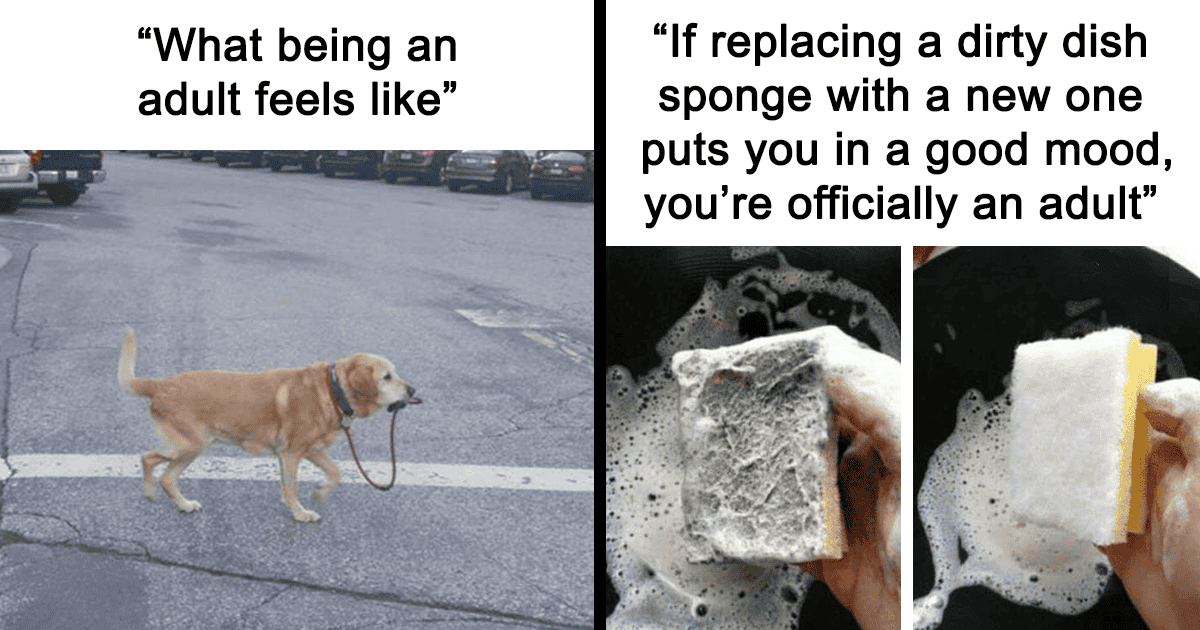

I know that zoomers are probably squirming right now because they find the word ‘adulting’ cringe, but most of you are still at school so you don’t get a say in this, OK?
Of course, as Julie Beck pointed out in The Atlantic, if we think of the transition to adulthood as a collection of markers (getting a job, moving away from your parents, getting married, and having kids), we’ll see that for most of history, except the 1950s and ’60s, people did not become adults in any kind of predictable way. In fact, many took so long to acquire the concept (or even avoided it altogether), that you might even build a case that no one is really a grown-up.
To illustrate just how chaotic adult life is, we at We have collected some of the most popular adulting memes on the internet. Take a look!
#1

#2

Diana Divecha, Ph.D., who is a Berkeley-based developmental psychologist, focusing on the science of how children, teens, and families grow and develop, toldWe that “developmental scientists consider adulthood to begin when the prefrontal cortex, the front-most region of the brain, finishes developing, at around 25 years of age.”
“This area is most well-known for its ‘executive function,’ or being the ‘manager’ of oneself. It supports abilities like planning ahead, regulating emotions and impulsivity, complex thought and reasoning, problem-solving and decision-making, and managing one’s attentional focus,” she explained.
#3

#4

Dr. Divecha pointed out that in WEIRD societies (Western, Educated, Industrial, Rich, Democratic), the onramp to adulthood has become very long—a period of about 10 to 15 years. She thinks of ‘entering adulthood’ as having three phases:
“The first phase begins with puberty, when the sex hormones begin their real job, to remodel the brain in order to prepare for adulthood. This is a time when respect from the peer group takes on new importance as nature prepares young people to eventually leave the nest and form new social groups.”
“But this can be a bumpy period at first, so it’s helpful for teens to stay open and optimistic, and to have a few different peer groups. It’s also easy to be impulsive in this phase, so cultivating discernment (wise decision-making and action), and taking a moment to think before acting can be helpful, and at times, even life-saving,” Dr. Divecha said.
#5

#6

#7

The second phase, according to the developmental psychologist, is identity exploration —a time when we start asking ourselves questions like: ‘Who am I?’ ‘What’s important to me?’ And ‘Where do I fit in?’
“This is a period of great creativity, so to the extent possible, it’s helpful totry new things and explore possible interests,” Divecha explained. “Some will fit, others will not, but all will be helpful information about what matters to each individual.Learn how the world works: Get real-world work experience, learn how corporations and social media manipulate the public for profit, work on real-world problems, and find adult mentors—they offer crucial bridges to adulthood. And finallylearn skills—practical skills like cooking, laundry, cleaning, and personal finance, as well as interpersonal communication and emotion-regulation skills.”
The third phase is early adulthood and it’s usually defined with first commitments to jobs/careers and relationships. “Learning from mentors and gaining emotional and interpersonal skills continue to be important. Flexibility and adaptability are key, too, as young adults frequently change jobs until they land one that feels like a good fit or they create their own independent/entrepreneurial path,” Divecha said.
#8

#9

#10

Some scientists who study the brain and nervous system say the age at which you become an adult (which is different for everyone) might even be your 30s.
One argument they use is that people around 18 years of age are still going through changes in the brain which can affect behavior and make them more likely to develop mental health disorders.
“What we’re really saying is that to have a definition of when you move from childhood to adulthood looks increasingly absurd,” Professor Peter Jones, from Cambridge University, told BBC News. “It’s a much more nuanced transition that takes place over three decades.”
#11

#12

#13

Jones thinks that structures like the education system, the health system, and the legal system simply make it convenient for themselves by having definitions.
Strange isn’t it? How many countries consider their citizens mature adults when they reach the age of 18 and allow them to vote, buy alcohol, and get a mortgage even though hitting that number doesn’t automatically transform you into a reasonable human being?
However, Professor Jones believes experienced criminal judges recognize the difference between a 19-year-old defendant and a “hardened criminal” in their late 30s.
“I think the system is adapting to what’s hiding in plain sight, that people don’t like (the idea of) a caterpillar turning into a butterfly,” he said. “There isn’t a childhood and then adulthood. People are on a pathway, they’re on a trajectory.”
#14

#15

#16

Reaching adulthood does not mean we stop changing. “Some core aspects of personality, like sensitivity, reactivity, or easy-going-ness, tend to be pretty stable from early in life throughout the lifespan. But your ability to know yourself and learn to express and manage your personality in fulfilling ways can improve a lot over time,” Divecha said. “You can learn when and how to modulate your personality to better fit a situation, or on the other hand, change your situation to better fit your personality.”
“And yet, outside events can still come along and radically change you. For example, if you had a rough start in life, a good relationship or therapy later in adulthood can transform the rest of your life for the better. Or, on the other hand, if your life has been going okay and you suddenly experience great adversity, that, too, can change you forever. The brain remains flexible throughout the lifespan but it is more easily adaptable early in life.”
So continue scrolling through the pictures and who knows, maybe they will not only entertain you but teach something as well.
#17

#18

#19


#21

#22

#23

#24

#25

#26

#27

#28

#29

#30

#31

#32

#33

#34

#35

#36

#37

#38

#39

#40

#41

#42

#43

#44

#45

#46

#47

#48

#49

#50
